Saturday, March 31, 2012

Lazarus - Arise!

Remembering back to last year, the kids really enjoyed our Lazarus Saturday activity so I'm posting it again with a few talking points to build into your lesson early enough, along with our favorite photos.

It's extremely significant that the Church places Lazarus Saturday exactly one week earlier than the Resurrection of Christ. It is a miracle for teaching us the power of God so that we may learn to truly believe and have our faith transformed at Pascha. Just as we begin Holy Week, we get a glimpse and foretaste of the way God will save the world from the corruption of death. As Christ said, Lazarus was merely sleeping. Although death had claimed him, and he smelled from the corruption of his body, he will live again. This is our Orthodox theology! Our view of death as sleeping. A joyful sorrow of what we are about to experience in Holy Week.

Remember: Lazarus is each one of us. Each and every time we attend a funeral or place a loved one in the grave, we should remember this very real example. How does God feel about each one of us? Does He weep for us as He wept for Lazarus? Is He a loving God? Why has He allowed Lazarus to die?

We find the answer in the words of Christ to His Father, which are for our benefit. He says, "So that they may believe."

Christ attends the funeral to join the people in their sadness, and to transform the event into a celebration of life! He turns our tears of sadness into tears of joy!


Friday, March 16, 2012

Song: Jesus Prayer

In response to your requests, below are the audio files to learn the Jesus Prayer as a song with your teens and children. There are a few versions below: Two are slow, in English or Greek, and the third is a faster version to a slightly different melody that is especially great for road trips.You'd be surprised how the time passes quickly with everyone involved in prayer! Use this song to specifically pray for the poor, the hungry, the orphans, all monks and nuns, anyone by first name, etc... Although, if you are familiar with the theology behind the Jesus Prayer, you know that by praying this for yourself, you are essentially including all mankind and asking for God's great and abundant mercy to save us!


The first is in English, and sung in rounds from the CD "Panaghia With Us All: Songs and Hymns with the Children of Saint Demetrios Greek Orthodox Church" recorded with Father Monk Christodoulos.

The second recording is simply the same melody in Greek: "Kyrie Isou Xriste, Yie tou Theou, Eleison Me"
And the third version...asking different members present to shout out the next name to pray for...


Saturday, March 10, 2012

Monks & Nuns


This Sunday the Orthodox Church commemorates Saint Gregory Palamas during Great Lent, and it might seem like a difficult example to draw a lesson from. If you are wondering how to make this Sunday relevant, consider teaching about the subject of monasticism since the Saint spent several years living and praying within a small cave outside of Thessaloniki, Greece. It can be a great opportunity to introduce to our youth the actual daily routine of an Orthodox monk or nun. Even the fact that in our tradition, we have monks and nuns!

In Greek "monos" literally means alone. Hence the word "monastic" - one who lives alone

Brief vocab for the lesson with a printable worksheet:
 
The Talanto - a long narrow piece of wood struck with a pallet by designated monks/nuns in the monastery as a call to prayer for the others to attend Church. This tradition comes from the great Prophet Noah, who hit the ark to call the animals to enter inside.

The Hours - or otherwise known as the daily rule of prayer - praying the hours happens six times a day, at symbolic hours. 7 am (first hour, sunrise), 9 am (third hour, time of the coming of the Holy Spirit at Pentecost), 12 noon (sixth hour, our Lord's sacrifice began at Golgotha), 3 pm (ninth hour, our Lord's sacrifice on the Cross ended as He gave up His spirit to the Heavenly Father), 6 pm (Vespers - setting of the sun), 9 pm (Compline - before sleep), 12 midnight ( in the silent darkness the soul rises for prayer)

Komboskini - or prayer rope, in several sizes. The most common is 33 knots for 33 years of Christ's life. It is made by the hands of the monks/nuns who recite the Jesus prayer while making each knot, sealing within it the name of Christ. After it is complete, the prayer ropes are used as tools to continue praying for others and the world, often never leaving the fingers of praying monastics!
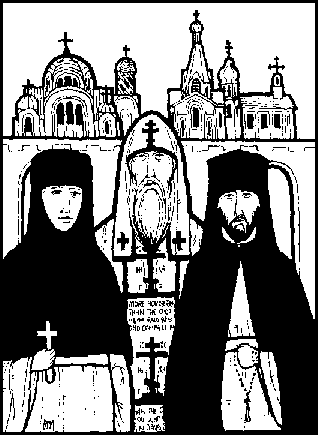
Tonsure -  this is the rite of initiation into the monastic state or the official blessing and becoming of a monk or nun in the Orthodox Church by a Bishop or Archimandrite. There are three levels: Rassophore, Stavrophore, and the Great Schema. The hair is cut as an offering of the person to God along with their whole life and their self will. Afterward the hair, even a beard, is never cut again. Vows of chastity, obedience and poverty are made with a commitment to strive within the monastery community of fellow brothers and sisters.

Ascetic - one who lives apart from the world to dedicate their life fully to God, sometimes in a cave or the desert. It is a very difficult life, with very little food, maybe dried bread or plants. Usually little clothing, a rock for a pillow and no dvd's, iphones or McDonalds!

Gerontissa, Geronda, Abbess, or Abbot - This is the spiritual mother or father assigned with the task of guiding and confessing the others monks and nuns to their salvation in Christ. Visitors to the monastery often bow and offer a kiss to their hand to take their blessing.
 
Novice - This is the title used for a beginner or interested person in becoming a monk or nun. Often this candidate will live within the monastery for several years as a trial to be certain before being tonsured. 

Trapeza - This is the dining hall where meals are shared all together. Fasting from meat is year round, and often spiritual food is offered simultaneously through reading or a small sermon. Sometimes, water is drunk only second to food when a small bell is rung, reinforcing the discipline of taming self will through obedience and gratefulness to God.


Diakonima – each monk or nun has specific work to complete that is assigned to them. Everyone works for the love of Christ and contributes to the community. Some cook, others garden, while another sews, and chants etc.

A monk or nun leaves the world to prayer for the world!

Explain that there are Orthodox monasteries around the world, and include a short description or slide show of photos from Mount Athos if you would like. Also share the location of an Orthodox Monastery near you. From personal experience, there is no greater impact on our youth than an actual visit to an Orthodox monastery first hand! Please consider arranging for a group trip from your parish, and expose this way of life to our young people.

A few children's books on the subject:

http://www.amazon.com/Abbot-As-Told-Josie-Cat/dp/188821225X

http://www.amazon.com/Song-Talanton-Claire-Brandenburg/dp/188821290X
Tuesday, March 6, 2012

Lent Crafts: Pascha Candles

In our parish, we try to offer a small craft related to Great Lent and Pascha each year. This year we have chosen to invite parents to decorate a "Lambatha, or Pascha Candle" with their children after the celebration of a Divine Liturgy on Sunday. Often these can be purchased with stuffed animals and ribbons, but we aim to use small icon stickers, wax decals, and symbols from our faith instead. Beeswax is an ideal offering, however white is also fitting for the Resurrection if this is what your parish offers.

Here are a few symbols to incorporate:
A small icon of the Resurrection
A Cross
Three Crosses
Alpha and Omega
Flowers
IC XC NIKA (Jesus Christ Conquers)
The "X" and P"
Christ is Risen


Here is a sample graphic to print on labels. If anyone else has done this craft before, please share your advice. I found the following links that were helpful:

http://festalcelebrations.wordpress.com/2008/02/13/baptismal-and-paschal-candles/

Secondly, a thought was offered to decorate the small plastic cup that is often used to catch the wax from burning little hands.

Or thirdly, you could decorate a small white lantern to take the "Holy Fire" home. This is helpful protection from the wind as well during processions!

Friday, February 17, 2012

Orthodox Coloring Books for Lent

The time has come for Great Lent 2012 - here are some extra resources to challenge your young ones! We have compiled a printable PDF workbook available for free at this Scribd link. It contains coloring icons, games and craft activities to accompany the Sundays during Lent as well as Lazarus Saturday and Holy Week. Please do not reproduce or sell this for profit in any way - it is simply available for parish and home use only.


To purchase other fantastic resources available in many languages visit http://orthodoxchildrensbooks.com. Potamitis Publishing has extremely reasonable prices which include even the cost of shipping! They have informed me that the workbooks
have nice explanations on each page in both Greek and English for example.


I wish you all a fruitful journey this year, with many blessings and illumination for a glorious Pascha celebration!

Wednesday, February 8, 2012

Lady Sarakosti Poem & Coloring for Great Lent


Quiet Lady Sarakosti, is a custom from long ago,
Our grandmothers used to make her, out of flour and H2O.

She wears a simple nun’s dress, with a cross upon her head, her hands in prayer without a mouth, to keep the fast with mostly bread.

Her feet teach us how to count, the weeks of Lent are seven, we cut one off each Saturday, until Pascha and the new heaven.

**If you make a better translation of the original Greek poem, please share it! This is also my version of a more Monastic Lady Sarakosti drawing with a prayer rope in hand and head veil**

Lady Sarakosti Recipe
2-2 1/2 cups flour
1/2 cup salt
2-2 1/2 tsp. cinnamon                            
water (as much as needed)        
* Not to be eaten! *

Combine flour, salt and cinnamon in a medium sized bowl and gradually add enough water to form a stiff, but flexible dough. Roll dough out to 1/2" thickness. With a sharp knife cut out the figure as shown above. Cut out two long narrow strips for arms and join at shoulders (wet surface to which arms will be applied). Make slits in dough for fingers.  Mark closed eyelids and noise with pointed object. Wipe entire figure down with a lightly dampened cloth to make shiny. Bake in moderate oven until golden.

Saturday, December 24, 2011

Why God Became Man?


“You must understand why it is that the Word of the Father, so great and so high, has been made manifest in bodily form."

“Christ has been manifested in a human body for this reason only, out
of the love and goodness of His Father, for the salvation of us men” 

“It was our sorry case that caused the Word to come down, our transgression that called out His love for us, so that He made haste to help us and to appear among us.


“…the human race was in process of destruction… what then was God, being Good, to do?”


“It was unthinkable that God, the Father of Truth, should go back upon
His word regarding death in order to ensure our continued existence.”

“…corruption could not be got rid of otherwise than through death” 


“For by the sacrifice of His own body He did two things: '
He put an end to the law of death which barred our way; and He made a new beginning of life for us, by giving us the hope of resurrection.”


"The word became flesh (that is, man), that the flesh might become God by grace; and He became like us in all things, that we might become like the Word in all of the virtues."
 
Quoted from 'On the Incarnation' by Saint Athanasios the Great. Read the whole treatise here at this link.  The above theology has been adapted for a curriculum located for free at this link.